
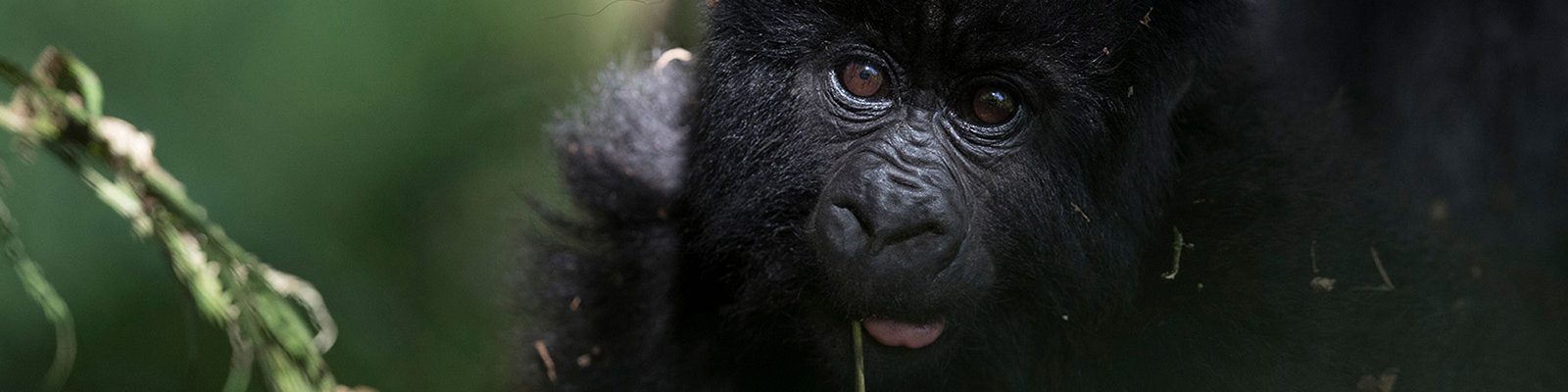
Wondering how the gorilla survive in the unforgiving, cold, thick forests of the Virunga? The Gorillas Adapt to the Environment in order to survive. Mountain gorillas are endangered species with a World population of only 1061 individuals living in the densely forested hills of Bwindi Impenetrable National Park in south-western Uganda) as well as the Virunga Mountains within Mgahinga Gorilla National Park (Uganda), Volcanoes National Park (Rwanda) and Virunga National Park (Democratic Republic of Congo). Uganda alone shelters more than half the World’s total population of these mountain gorillas, making it the best place to trek the gorillas with over 12 habituated gorilla families thus 168 permits available per day. Due to the high altitude, the gorillas have
These Great Apes occupy the cold and Mountainous Tropical rainforests (2500 to 4000 meters above sea level) and this brings us to the question of how gorillas adapt or survive in their environment?
Their herbivorous Nature.
Mountain gorillas are herbivores with their diet comprising of fruits, leaves, bamboo shoots, roots and pant stems making it easy for them to find food in the Tropical rainforests where the live. Because their food is readily available in every corner of their natural habitats, mountain gorillas are saved from moving to far places in search of food.
Imagine the hustle they would go through to find food in the forest if they were carnivores. They definitely don’t have to chase and kill prey.
Their long and thick fur.
Mountain gorillas live within dense forests high in the mountains, with altitudes ranging from 2500 to 4000 meters. Daytime temperatures of these habitats range from 10 Celsius degrees to 21 Celsius degrees, and sometimes even dropping below freezing at night.
Mountain gorillas have longer and thicker fur compared to other species of great apes (including the other three gorilla sub-species). Their darker, longer and thicker fur helps them to comfortably live and survive in their natural habitats.
Use of body language and vocalizations as a means of communication/socialization.
Mountain gorillas communicate through facial expressions to convey emotions, needs as well as desires to fellow gorillas.
Their strong and small fingers make it easy to find food.
Mountain Gorillas have small but strong fingers that help them to effectively gather and prepare fruits, seeds, roots, leaves and plant stems before feeding on them. Their fingers not only make food gathering easy but also help them to fight when they perceive danger and threat to their group/family.
Their stocky and strong arms are also used for movement from one location to another when searching for food or even finding a comfortable place to nest.
Their outstanding leadership system.
The leadership system of mountain gorillas is unique in such a way that one silverback heads the group/family and he is in-charge of making final decisions such as where they feed, nest as well as wake-up time.
He is also the only one allowed to make/father off springs in the family. This helps mountain gorilla groups to live peacefully and if any silverback wishes to enjoy these privileges, he is allowed to leave and form his own family.
Massive Size.
Mountain gorillas have massive body sizes to help them easily climb mountains to find food-fruits, seeds, roots, stems and leaves to feed on. Also, their big sizes and strength protect them from predators, since many animals fear them. It is very difficult (not impossible) for leopards or lions to prey on mountain gorillas.
Secretive nature.
Mountain gorillas are generally secretive in nature, often using their unique sense of hearing and smelling to detect danger or threats from afar. They will then secretively run into hiding and protect themselves from any unexpected dangers.
All the above reasons give the mountain gorillas an advantage for the Gorillas to Adapt to the Environment.
These extraordinary gorilla behaviors can be witnessed by booking gorilla safaris in Uganda, Rwanda or DRC. Gorilla Permits go for only $700 for Uganda, $400 for D.R. Congo and $1500 for Rwanda. Gorilla treks are conducted all year round although the dry months of January, February, June, July, August, September and December are usually preferred for these safaris.
During these months, there are lower chances of rainfall thus hiking trails are not muddy or slippery and the forest floor is also drier hence more favorable for gorilla treks.


